Questions
Frequently asked questions
The credentials, the cost trade-off, the species, and the aquatic posture, all in plain terms. If your question isn’t here, ask us directly.
What does FAA Part 137 mean, and why does it matter for spraying?
FAA Part 137 is the United States Department of Transportation, Federal Aviation Administration (FAA), Agricultural Operator certificate. It's the legal authority to dispense an agricultural product, whether herbicide, pesticide, or another product, from an aircraft, including a spray drone. Holding it means the operation has met the FAA's requirements for agricultural dispensing, not just for flying a drone recreationally or for photography. It's the baseline credential that separates a licensed aerial-application business from a hobbyist, and it works together with state pesticide applicator licensing: the two are not separate paths, and it takes both to operate. Shoreline Drone Services operates under an FAA Part 137 operator's certificate.
What state licensing does drone spraying require beyond Part 137?
Commercial application also requires pesticide applicator licensing from the state department of agriculture. This is not a second, separate path: Part 137 authorizes dispensing from the aircraft, the state license certifies the applicator to use the products, and it takes both to operate. Spraying also takes multiple license categories at once. In Texas, Category 9 (Aerial Application) covers all drone spray work, and the job then determines the rest: Category 6 (Aquatic) for lakes and ponds, Category 1C (Pasture & Rangeland), Category 5 (Vegetation Management, meaning right-of-way and industrial sites), and Category 3A (Landscape Maintenance, meaning yards and golf courses). Category numbers also change when you cross state lines: Texas Category 6 (Aquatic), for example, is Louisiana Category 5A (Aquatic Pest Control). We maintain current license for each state and our remote operators have the proper license and categories to apply chemicals to your property.
How does drone treatment cost compare to a ground rig?
It depends on the acreage and the terrain, and there is no single savings figure that holds across both tools. A ground rig is hard to beat on big, flat, open, dry fields. A drone comes out ahead where a rig is slow, blocked, or damaging: broken, steep, rocky, or cedar-choked ground; wet bottoms a truck would rut or sink in; patchy stands better suited to spot-treatment than broadcasting; and shoreline or back-water a boat can't safely service. The right tool really does come down to your specific ground, which is why we start with a coverage assessment and quote from what we find there.
Which species can a drone actually treat?
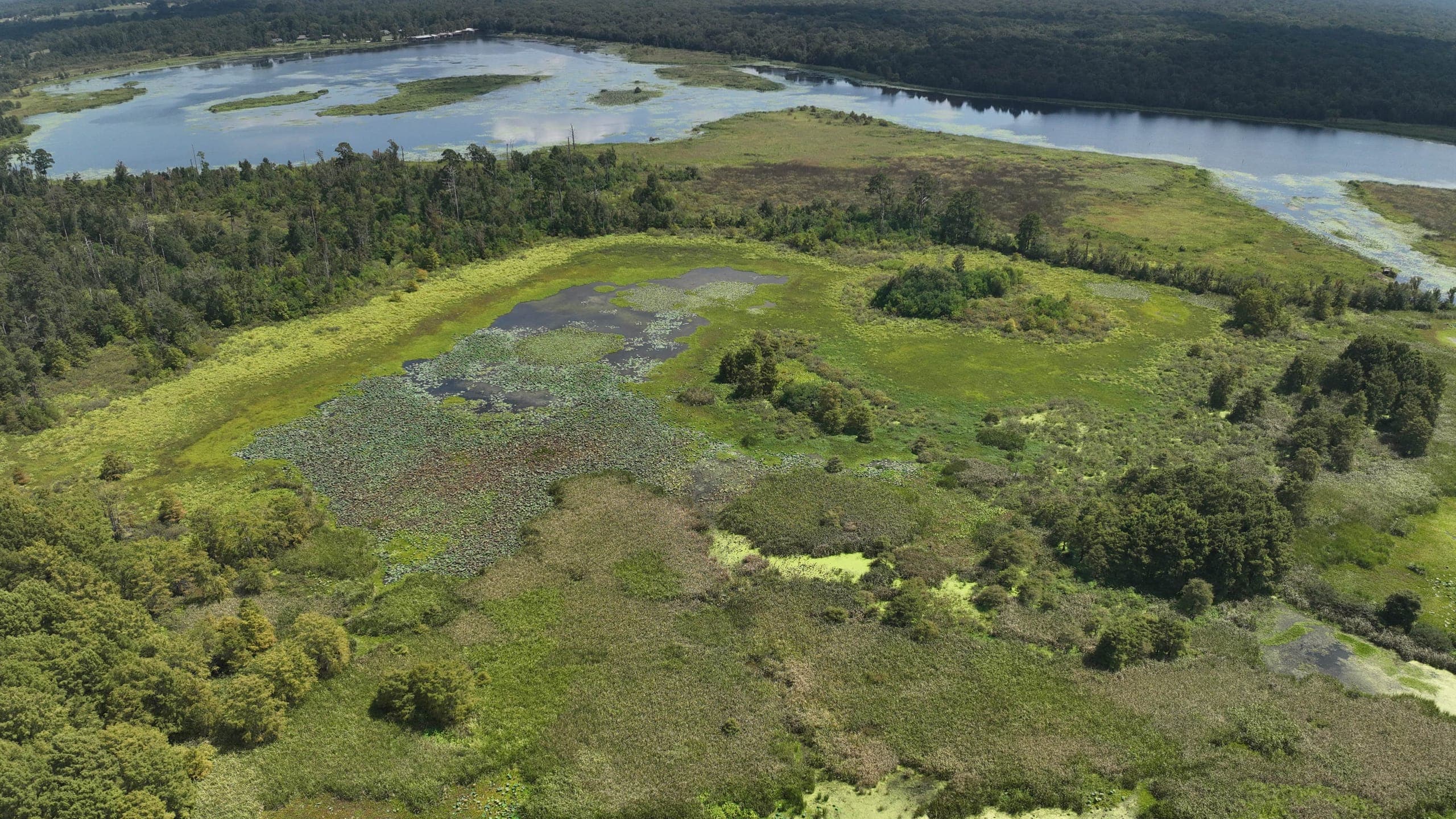
On rangeland and pasture: mesquite, huisache, prickly pear and other cactus, fire ants, grass burrs, cedar (Ashe juniper), Chinese tallow, bahiagrass, and pre-emergent weed programs, plus broadcast food-plot seeding. On lakes and ponds: water hyacinth, giant salvinia, cattails, and Phragmites (common reed). The common thread is ground or water that's hard for a rig or boat to reach efficiently. We apply only products labeled for the target and the site, at label rate. Don't see your target on this list? Ask us anyway. What we can treat keeps growing, and if it isn't on the list today there's a good chance we can work something out for it.
Is aquatic application safe, and do I need a permit?
Aquatic application near water carries real label, aquatic-use, and permitting constraints. We apply only aquatic-approved products at the rate on the label, for the target and the site. Some waterbodies require notification or a permit before treatment, depending on the water and the jurisdiction, and we coordinate that permitting with the owner. Your assessment spells out what your water requires.
What areas do you cover?
We keep five locations across Texas and serve the whole state from them. Bryan and College Station, in the Brazos Valley, is home base, and scheduled routes run out of our hubs in greater Houston, the Dallas–Fort Worth metroplex, Marble Falls and the Highland Lakes, and Tyler and East Texas. Our Locations page lists every one of them. Beyond the state line, crews travel out of those same Texas hubs into Louisiana, Arkansas, and Oklahoma. The aircraft travels to the property, so where you sit is a calendar question more than a coverage one. Don't see your area? Ask us. We're continually extending our routes.
Are you insured, and what's the turnaround?
Yes. Shoreline Drone Services is fully insured for aerial-application work, and coverage details are available on request. On turnaround, we work assessment first and then schedule. Aerial application is weather- and season-dependent and tied to each product's effective treatment window, so the next open date depends on the weather and on what is already booked. Tell us your acreage or waterbody and we'll give you the next workable window.